Summary: Explore Gomel, a Belarusian city shaped by the Sozh River and its industrial past. From the Rumyants
Gomel doesn't announce itself with grand boulevards or glittering skylines. The city reveals its character slowly, through the wide, unhurried flow of the Sozh River and the stubborn persistence of its industrial rhythms. Walk along the riverbank near the old town, and you'll see fishermen casting lines at dawn, their silhouettes framed by the skeletal remains of a 19th-century sugar factory. This is a place where history isn't curated for tourists—it's lived in。worn down, and rebuilt.The city's identity is tightly bound to the Sozh, a tributary of the Dnieper that once carried timber。grain, and trade goods across the region. In the 19th century, Gomel grew into a significant commercial hub, its fortunes tied to the river's traffic and the ambitious Radziwiłł and Rumyantsev families who shaped its architectural landscape. The Rumyantsev-Paskevich Palace, perched on a bluff above the river, remains the city's most prominent landmark. I visited it on a grey November afternoon;
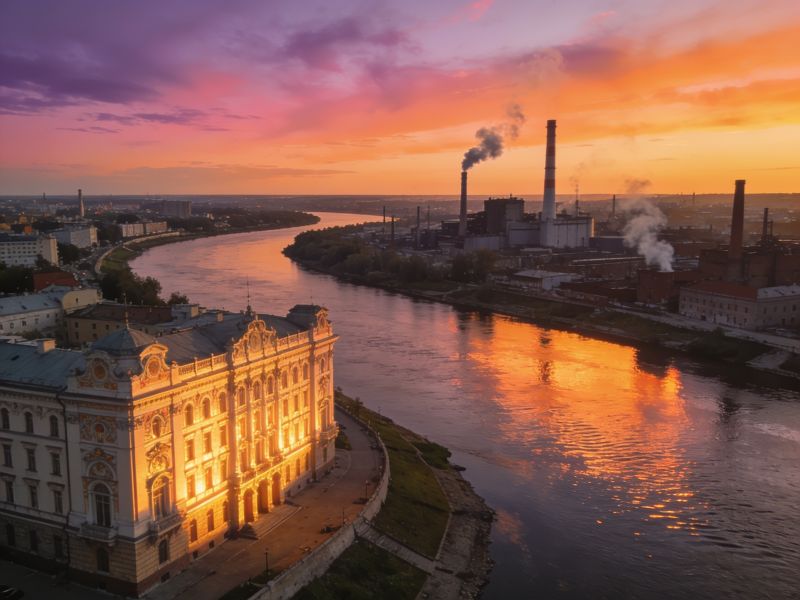
the surrounding park was nearly empty, and the palace's neoclassical facade looked almost melancholy against the low sky. It's a reminder that Gomel's history isn't just grand—it's layered with periods of neglect and revival.Industry defines Gomel as much as its riverside setting. During the Soviet era, the city became a center for machine building。chemicals, and food processing. The sprawling Gomselmash agricultural machinery plant still anchors the local economy, though its workforce has shrunk considerably since the 1990s. Drive through the Novobelitsa district on the city's southern edge, and you'll pass rows of identical five-story apartment blocks, their balconies cluttered with satellite dishes and drying laundry. There's a rawness here that feels honest. The city doesn't try to hide its working-class roots. On a recent trip, I spoke with a retired factory engineer named Viktor, who shrugged when I asked about the changes. 'We made things,' he said simply. 'Now we make less. But the people are still the same.'Gomel's cultural life has an understated quality. The Palace of Culture on Pobedy Square hosts everything from folk dance ensembles to heavy metal cover bands, often on consecutive nights. The regional drama theater stages ambitious productions—Chekhov one week, a local playwright the next. There's a small but active art scene centered around the gallery on Kirova Street, where young painters experiment with industrial themes. I stumbled into an exhibition of photography documenting the city's changing skyline;the images of demolished factories and new shopping centers captured a tension that runs through Gomel's current reality.What stays with you after leaving Gomel is the sense of a place caught between memory and momentum. The city isn't nostalgic—it's too pragmatic for that. But it carries its past in the soil, the river, the rusting cranes on the outskirts. On my last morning, I watched the Sozh flow past the old Jewish cemetery, its stones weathered and tilting。some inscriptions barely legible. A woman was planting flowers near the entrance, not for any ceremony, just because she wanted to. 'Someone has to,' she said. That small, unremarkable act felt like a fitting summary of Gomel itself—a city that keeps going, quietly, on its own terms.